
- 1️⃣ The Starting Point: Global Gold Price
- 2️⃣ Converting Global Price to Per Gram in INR
- 3️⃣ Import Duties: Why India’s Gold Price Is Higher Than Global
- 4️⃣ GST: Tax at the Point of Sale
- 5️⃣ Purity Matters: 24K vs 22K Pricing
- 6️⃣ Making Charges & Retail Premiums
- 7️⃣ Currency Fluctuations: The Rupee Effect
- 8️⃣ Seasonal & Demand Factors
- 9️⃣ Step-by-Step Example
- 10️⃣ Why 1 Gram Gold Price Changes Daily
- Final Takeaway
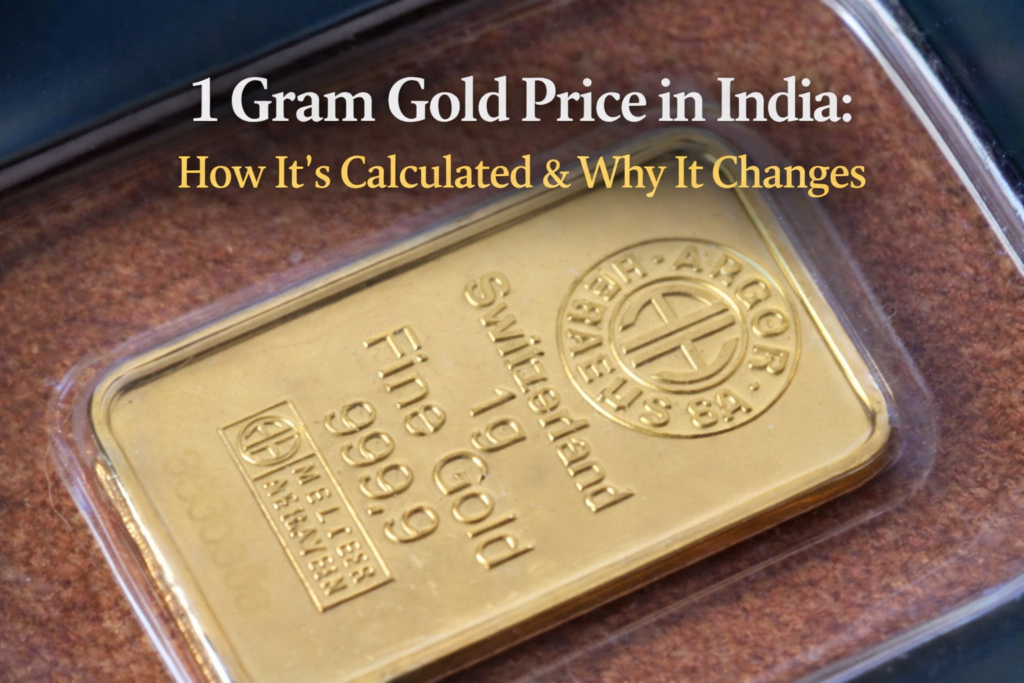
Gold holds emotional and financial value in India — whether you’re buying 1 gram gold jewellery as a gift or tracking the cost of 1 gram gold as an investment. But have you ever wondered how that number is actually calculated?
The truth is, the 1 gram 24kt gold price you see at a jewellery store isn’t random. It’s built step-by-step from global benchmarks, currency rates, import duties, taxes, and retail charges.
Let’s break it down clearly and simply.
1️⃣ The Starting Point: Global Gold Price
The foundation of India’s gold pricing system is the international benchmark price.
According to the World Gold Council, gold prices are determined globally in US dollars, typically quoted per troy ounce. One of the most widely used benchmarks is the LBMA Gold Price, administered by the London Bullion Market Association.
The LBMA Gold Price is discovered through an electronic auction process conducted twice daily. This benchmark reflects large-scale global trading activity and serves as the base reference for countries worldwide.
So before gold even reaches India, its price is already influenced by:
- Global demand and supply
- Inflation expectations
- Interest rates
- Geopolitical events
- Investment flows into gold ETFs
This gives us the international spot price (USD per troy ounce).
2️⃣ Converting Global Price to Per Gram in INR
Gold internationally is quoted per troy ounce, not per gram.
According to pricing breakdown guides such as those from Navia, one troy ounce equals:
31.1035 grams
So here’s the core formula used to calculate the base Indian value:
Step 1: Take international gold price (USD per ounce)
Step 2: Multiply by current USD/INR exchange rate
Step 3: Divide by 31.1035
This gives you the base INR value per gram — before taxes and duties.
This is the fundamental answer to:
How much gold in 1 gram?
Pure gold weight = 1 gram.
Market value = derived from the formula above.
But this is still not the retail price you pay.
3️⃣ Import Duties: Why India’s Gold Price Is Higher Than Global
India imports most of its gold. So import duties significantly impact the cost of 1 gram gold domestically.
In July 2024, as reported by Reuters, India reduced its gold import duty from 15% to 6%. This policy change directly affected local pricing and reduced unofficial supply channels.
Import-related regulations are governed by Indian customs authorities such as Mumbai Customs Zone III, which outline import rules and applicable duties.
Import duty is added to the base converted price, increasing the landed cost of gold in India.
So now we have:
International price (converted to INR/gram)
- Import duty
= Landed gold cost in India
4️⃣ GST: Tax at the Point of Sale
Once gold reaches the retail level, GST applies.
According to tax explanations from ClearTax:
- 3% GST is charged on gold value
- 5% GST is charged on making charges
This is important when calculating final jewellery prices.
So your bill typically includes:
- Gold value
- Making charges
- GST on gold
- GST on making charges
This explains why the 1 gram gold jewellery price is always higher than the raw bullion rate.
5️⃣ Purity Matters: 24K vs 22K Pricing
When people search for:
1 gram 24kt gold price
They’re referring to pure gold (99.9% purity).
But most jewellery in India is made from 22K gold, not 24K, because pure gold is too soft for durable ornaments.
Price calculation difference:
- 24K gold = highest per gram rate
- 22K gold = 91.6% of 24K purity
- 18K gold = lower gold content
So if you’re buying 1 gram of 22K jewellery, the gold value is:
24K price × 91.6%
Then making charges and GST are added.
6️⃣ Making Charges & Retail Premiums
Jewellers add making charges to cover craftsmanship, labour, and business margins.
According to industry explanations like those from Oropocket and pricing blogs:
Making charges may be:
- A fixed rate per gram
- A percentage of gold value
For small items like 1 gram gold jewellery, making charges can significantly impact the final price because labour cost doesn’t shrink proportionally with size.
This is why:
- A 1 gram ring may have a higher effective per-gram cost than a 50 gram necklace.
7️⃣ Currency Fluctuations: The Rupee Effect
Even if international gold prices stay stable, Indian prices can change daily.
Why?
Because gold is priced globally in US dollars.
If:
- The rupee weakens → Gold becomes more expensive in India
- The rupee strengthens → Gold becomes cheaper
So the cost of 1 gram gold depends not just on global price but also on USD/INR exchange rate movements.
8️⃣ Seasonal & Demand Factors
India’s gold demand spikes during:
- Wedding season
- Diwali
- Akshaya Tritiya
Higher retail demand can increase local premiums.
Market tracking platforms such as Multi Commodity Exchange of India also reflect domestic trading trends that influence price perception and retail movement.
When demand surges, jewellers may adjust pricing slightly above base rates.
9️⃣ Step-by-Step Example
Let’s simplify the entire flow:
- Global gold price (USD/oz)
- Convert to INR using exchange rate
- Divide by 31.1035 to get per gram
- Add import duty
- Add jeweller margin
- Add making charges
- Add 3% GST on gold value
- Add 5% GST on making charges
Final output = Retail 1 gram gold jewellery price
That’s how the number you see on the shop board is formed.
10️⃣ Why 1 Gram Gold Price Changes Daily
It fluctuates because of:
- Global gold market movement (LBMA benchmark)
- USD/INR exchange rate
- Import duty changes
- Government policy
- Inflation & interest rates
- Domestic demand
- Retail margins
So when someone asks:
“Why did gold go up today?”
It could be currency, global demand, policy news, or a combination of all three.
Final Takeaway
The 1 gram 24kt gold price in India is not arbitrary. It is built from:
Global benchmark → Currency conversion → Import duty → Domestic taxes → Making charges → Retail margin
Understanding this breakdown helps you:
✔ Compare jeweller rates
✔ Check bill transparency
✔ Understand purity differences
✔ Make smarter buying decisions
Whether you’re investing or buying 1 gram gold jewellery for personal use, knowing how the system works gives you clarity — and confidence.